
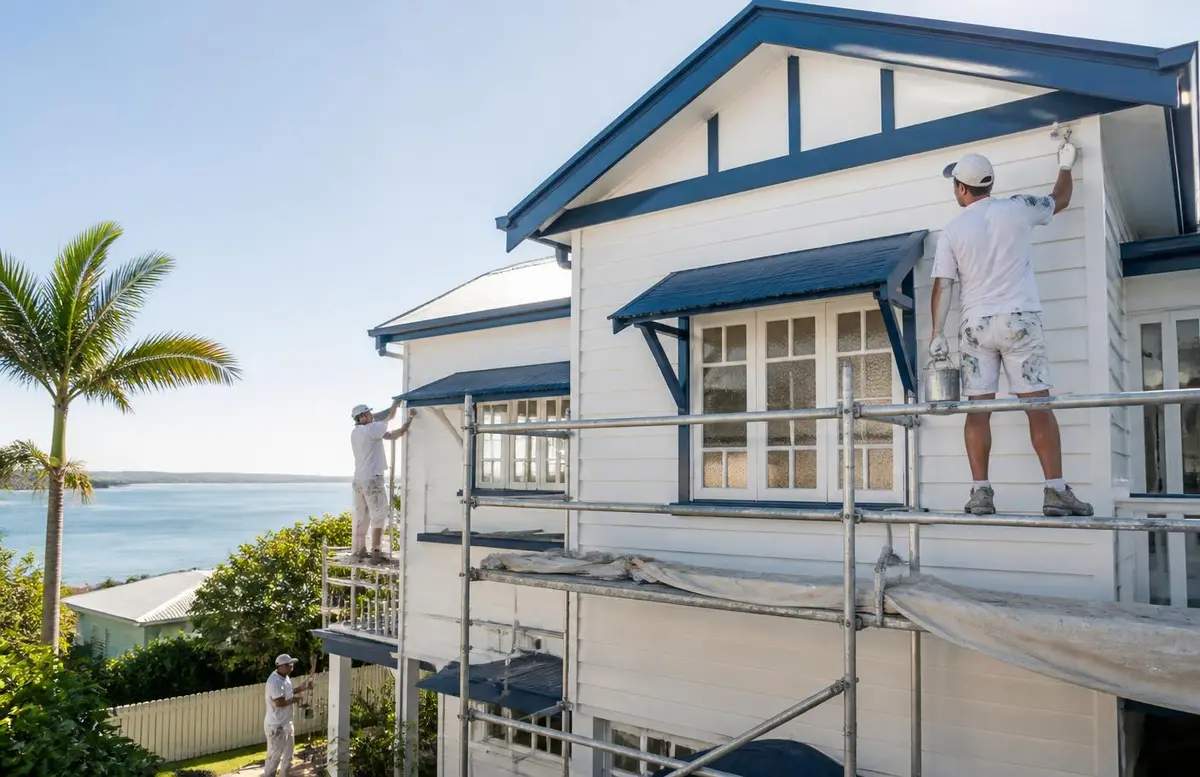
One of the most common calls we get from homeowners across Pialba, Scarness and Urangan starts the same way: “Do I need a full repaint, or can you just touch up the bad bits?” It is a fair question, and the honest answer depends on whether the coating failure you are seeing is localised or systemic. Get this diagnosis wrong and you either waste money repainting a house that only needed spot repair, or you patch a house that is going to keep failing within a year. This guide walks through how we make that call.
Localised failure versus systemic failure
Localised failure is confined to a specific cause: a leaking gutter that has stained one section of fascia, a downpipe overflow that has blistered paint at one corner, or a garden bed splashing soil onto a low wall during storm season. Systemic failure is different — it shows up as a pattern across most or all of an elevation, or across the whole house, and points to the coating itself reaching the end of its service life or having been applied over an unsuitable surface in the first place.
In Hervey Bay’s humid subtropical climate, systemic failure is often accelerated by UV exposure on north and west-facing walls, and by salt-laden sea breezes on properties closer to the Esplanade, Point Vernon and Urangan foreshore. If chalking, cracking or peeling is widespread rather than isolated to one damaged spot, you are almost certainly looking at a full repaint rather than a touch-up.
Signs that point to a spot repair
- A single water stain or blister traced to a fixable moisture source, such as a blocked gutter
- Fresh impact damage — a scuff, a knock from furniture removal, a dented downpipe bracket area
- Small hairline cracks in an otherwise sound, well-adhered coating
- Fading or dirt build-up confined to a shaded, low-traffic area rather than the whole wall
Signs that point to a full repaint
- Chalking (a powdery residue that rubs off on your hand) across most of a wall or the whole house
- Cracking, flaking or peeling appearing in multiple, unrelated locations
- Widespread colour fade, especially on north and west elevations that cop the most UV
- Coating failure at multiple different substrates — timber, render and fascia all failing together
- A previous coating system that is simply too old and has lost adhesion generally
Adhesion testing before you commit either way
Before recommending a touch-up or a repaint, we test how well the existing paint is actually bonded to the surface. This matters because a house can look tired but still have a sound, well-adhered base coat that only needs cleaning and a fresh top coat — or it can look reasonable from the street but be barely hanging on.
The cross-hatch test
A simple cross-hatch test involves scoring a small grid of shallow cuts into the paint film with a blade, in an inconspicuous spot, then applying and removing a strip of adhesive tape across the grid. If the paint lifts away in the squares, adhesion has failed and any new coat applied over the top will fail with it, regardless of how good the new paint is. If the grid stays intact, the existing film is a workable base.
Painting over a coating with poor adhesion is one of the most common causes of early repaint failure. No amount of premium paint will fix a bond problem underneath it — the surface has to be sound, or prepared back to one that is, before new paint goes on.
The colour-matching problem with touch-ups
Even when a touch-up is structurally appropriate, there is a separate issue: will it actually blend in? Paint fades over time from UV exposure, and a can of the “same” colour applied years later will often look noticeably different from the surrounding, sun-faded wall — brighter, flatter or slightly off-tone. This is especially obvious on darker colours and on walls that get direct afternoon sun, which is most west-facing walls in Hervey Bay.
Sheen flashing
Sheen flashing is the other giveaway — where a patch of paint reflects light differently to the surrounding area because the new film has a different gloss level, even in the same product line, or because the old surface has weathered to a flatter sheen than it started with. Under low morning or evening light along streets like the Esplanade, a poorly blended touch-up can be more visually obvious than the damage it was meant to hide.
- Touch-ups blend best on lighter, low-sheen colours in shaded areas
- Touch-ups are most visible on dark, high-sheen colours in direct sun
- Feathering the edges of a touch-up and cutting in at a natural break (a corner, a joint) helps disguise it
- A test patch in an inconspicuous area first is worth the extra ten minutes
The cost-efficiency logic, without the price tags
We won’t quote figures here, but the underlying logic is straightforward. Spot repairs are efficient when the problem is genuinely contained, because you are paying for labour and materials on a small area rather than the whole house. They become false economy when the underlying coating is failing broadly, because you end up paying for repeated patch jobs over a couple of years that never really solve the problem, and you often pay more in total than one properly staged repaint would have cost.
The other factor is preparation. A full repaint lets you properly wash, sand, prime and seal the whole house in one coordinated process. A series of touch-ups rarely gets the same level of preparation, because it is being done reactively, area by area, which is part of why patched houses tend to need attention again sooner.
Staging a repaint by elevation
If a full repaint is the right call but budget or scheduling means it needs to happen in stages, elevation is the sensible way to split the job. North and west-facing walls in Hervey Bay take the heaviest UV load and will generally show wear first — these are the priority. South-facing walls, particularly shaded ones, are more prone to mould and moss than sun damage and can sometimes wait a little longer if they are otherwise sound.
- Stage 1 priority: north and west elevations with the most sun and visible fading
- Stage 2: east elevations, which get morning sun and moderate weathering
- Stage 3: south elevations and shaded areas, often needing mould treatment more than UV repair
- Trims, fascia and gutters can be assessed and staged separately from wall colour if needed
If you stage a repaint over time, use the same product line and colour batch across all stages where possible. Mixing different paint batches or product ranges across elevations painted months apart is one of the more common causes of visible colour mismatch later.
When partial work is genuinely the right call
Not every ageing house needs a full repaint immediately. If your home is generally sound, the existing coating passes an adhesion check, and the issues are limited to a defined cause — a gutter that has since been fixed, a fence line that copped some weed spray overspray, a section knocked during landscaping — a well-prepared and carefully blended spot repair is a sensible, lower-disruption option. The key word is “well-prepared”: proper cleaning, sanding of the repair edges, and correct primer where bare timber or render is exposed, even for a small patch.
A quick decision checklist
- Is the failure confined to one identifiable cause and area? → Spot repair is reasonable
- Does the cross-hatch test show good adhesion elsewhere on the house? → Spot repair is reasonable
- Is chalking, cracking or fading showing up in multiple unrelated areas? → Full repaint
- Is the existing coating more than a decade old with no maintenance history? → Full repaint
- Will a colour or sheen mismatch be highly visible from the street? → Consider a full elevation repaint instead of a patch
Getting an honest assessment
Because this decision affects both the look and the lifespan of your paint job, it is worth having it assessed in person rather than guessed at from a few photos. We inspect the coating condition across each elevation, run adhesion checks where needed, and give you a straightforward recommendation — spot repair, staged repaint, or full repaint — based on what the house actually needs, not what is easiest to sell.
If you are staring at a tired-looking house and not sure whether it needs a touch-up or a full repaint, we are happy to come and take an honest look. Call now on +61 7 4428 2846 or email quotes@housepaintersherveybay.com.au to arrange an assessment.
Questions about your own property?
Call Now — +61 7 4428 2846For a local assessment, explore our house painting service in Hervey Bay or ask about work in Dundowran.
Request an on-site painting assessment