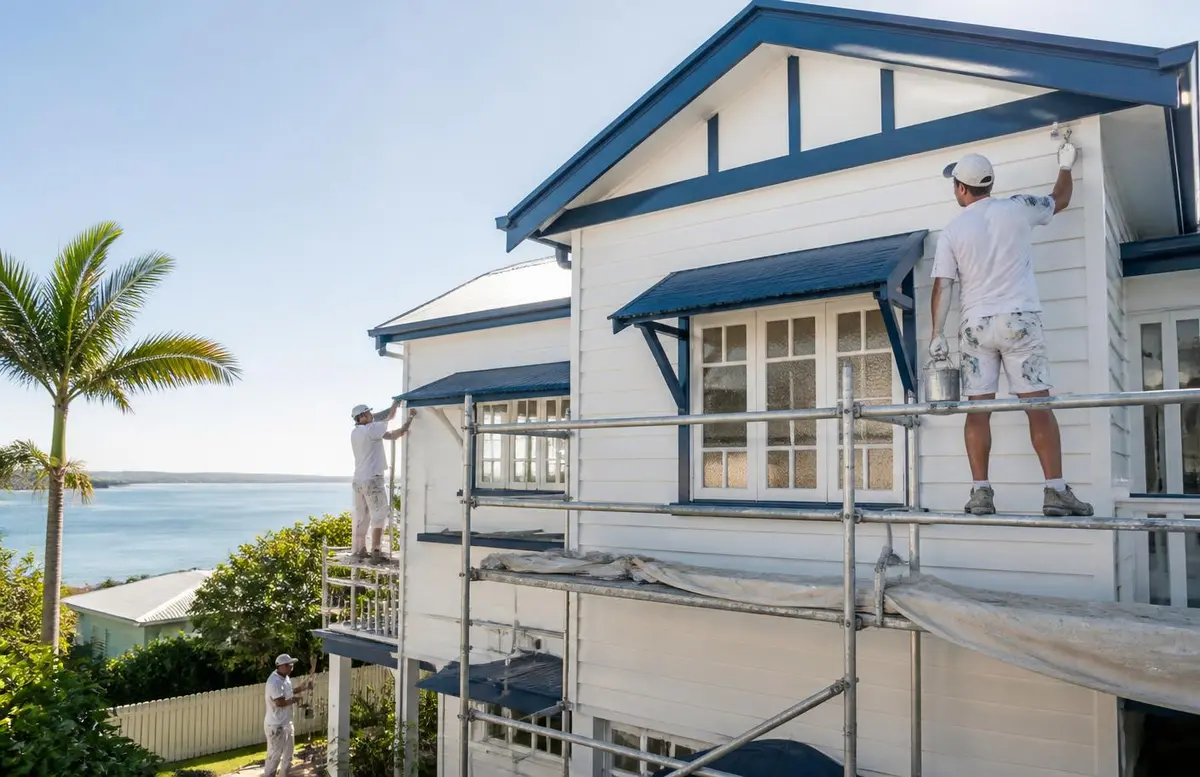
Roof Painting in Hervey Bay — Done Properly, First Time
Roof coating assessed from safe access, with the material and existing finish checked before anything is quoted. Cleaning, compatible primers and overspray protection are set out in writing, along with anything a coating cannot fix.
Roof painting can refresh appearance and protect a suitable surface, but it is not a substitute for structural repair. We first assess the roof material and coating condition from a safe position.
A roof coating that fails in Hervey Bay usually fails for the same reasons: intense UV, salt-laden sea breezes off the Coral Sea, and driving rain during the November to March storm season. House Painters Hervey Bay carries out roof painting and restoration on Colorbond, zincalume, cement tile and terracotta tile roofs across Pialba, Scarness, Torquay, Urangan, Point Vernon, Kawungan, Urraween, Eli Waters, Dundowran, Dundowran Beach, Craignish, Nikenbah, Wondunna and Booral, working from a proper inspection through to a heat-reflective topcoat that is built for this coastline rather than a generic finish. Call now on +61 483 709 394 to arrange a roof inspection and an obligation-free quote.
01
Why roof coatings matter on the Fraser Coast
Roofs in the Hervey Bay area cop a harder life than most people realise. UV exposure here is consistently high year-round, which breaks down the resins in factory-applied paint finishes on Colorbond and zincalume sheeting over time, and it chalks the glaze on cement tiles. Salt-laden air moving in off the Esplanade and Urangan foreshore accelerates corrosion at cut edges, screw heads and valleys, while summer storm season brings sudden downpours that expose any weakness in flashings, ridge capping or tile bedding. A roof coating is not just a colour refresh — done properly it is a maintenance intervention that protects the substrate, restores reflectivity, and can meaningfully extend the working life of the roof before replacement becomes necessary.
Because roof work involves height, slope and the risk of consequential water damage if it is done poorly, it is one of the areas where professional preparation and the right coating system matter more than brand loyalty to any single paint range.
02
What our roof painting service includes
✓Pre-quote roof inspection covering sheet or tile condition, fastener corrosion, flashings, ridge capping and valleys
✓High-pressure cleaning to remove moss, lichen, algae, chalking paint and airborne salt residue
✓Rust treatment and spot priming on metal roofs
✓Repointing or re-bedding assessment on tiled roofs where required before coating
✓Masking and protection of gutters, downpipes, solar panels, skylights and whirlybirds
✓Application of primer or sealer coats suited to the substrate
✓Application of a heat-reflective or membrane topcoat system in the chosen colour
✓Final check of penetrations, flashings and roof-to-wall junctions
03
Surfaces and materials we work on
Colorbond and zincalume metal roofs
Colorbond sheeting is common on newer builds around Urraween, Kawungan and Eli Waters, while older zincalume roofs still turn up on established homes closer to Pialba and Scarness. Both substrates need to be clean, free of loose corrosion and properly primed at bare metal or rust spots before a topcoat goes on, otherwise the new paint will simply lift off the compromised surface underneath.
Cement tile roofs
Cement tiles are porous and lose their factory glaze over the years, leaving a chalky, faded surface that absorbs water and grows moss readily in shaded, moist areas such as roof valleys facing south or under overhanging trees. Coating cement tiles seals that porosity, restores colour depth, and reduces the amount of moisture the tile itself holds.
Terracotta tile roofs
Terracotta is less common but still found on some older Hervey Bay homes, particularly around Point Vernon and Torquay. Terracotta needs a breathable coating system rather than a hard, impermeable film, since trapping moisture inside the tile body can cause spalling and cracking over time.
04
Roof inspection before any quote
Every roof job starts with a proper inspection, either from the roof itself (where access and pitch allow it safely) or from ladders and elevated vantage points where the pitch, height or fragility of the roof makes walking it unsafe. We are checking for corrosion at fastener heads and sheet laps, cracked or slipped tiles, deteriorated bedding and pointing along the ridge, rust bleeding through old paint, ponding areas, and the condition of flashings around chimneys, vents and skylights. This inspection determines the scope of preparation and whether a roof is a good candidate for coating at all.
05
Safe access and height safety
Roof work is height work, and it is treated that way. Depending on the roof pitch, height and layout, access may involve extension ladders, roof ladders and walk boards to distribute weight safely across tiles, harness and anchor point systems, and edge protection where appropriate. Two-storey homes and steeper roof pitches around Urangan and Craignish often need additional equipment and planning compared with single-storey homes on flatter blocks in Nikenbah or Wondunna. Correct access equipment protects both the crew and the roof itself — walking a tiled roof incorrectly is a common cause of cracked tiles that then need replacing before coating can proceed.
06
Cleaning, moss and lichen removal
High-pressure cleaning is the first physical step on almost every roof job. It strips loose, chalking paint, removes moss and lichen colonies (which take hold readily on shaded or south-facing roof planes in Hervey Bay’s humid climate), and clears general airborne grime and salt film. Pressure and technique are adjusted for the substrate — tiles can be damaged by excessive pressure held too close, while metal roofs need care around laps and fasteners to avoid forcing water underneath the sheeting. Any remaining moss growth in shaded gutters or valleys is treated separately, as simply pressure washing over an active growth without treatment often sees it return within a season.
07
Rust treatment and priming
On metal roofs, any corrosion found during inspection and cleaning is mechanically treated — typically wire brushing or grinding back to sound metal — then treated with a rust converter or inhibitor and spot-primed before the main coating system goes on. Skipping this step is one of the most common causes of early coating failure, because paint applied directly over active rust will bubble and lift as the corrosion continues underneath. Cut edges, screw penetrations and roof valleys are inspected particularly closely, as these are the points where zincalume and Colorbond roofs typically show the earliest signs of coating breakdown near the coast.
08
Repointing and bedding before coating tiled roofs
For cement and terracotta tile roofs, ridge capping is bedded onto a mortar bed and finished with a pointing mix, and both deteriorate with age and UV exposure. Cracked or crumbling pointing is one of the most common sources of roof leaks that homeowners mistake for a tile problem. Before any coating is applied, we assess whether ridge capping needs to be re-bedded and re-pointed, since coating over failing pointing will not stop water ingress and can trap moisture against deteriorating mortar. Where flexible pointing products are appropriate, these are used to reduce cracking from thermal movement in Hervey Bay’s temperature swings between summer heat and cooler winter mornings.
09
Coating systems: membrane and heat-reflective options
Modern roof coating systems generally fall into a few categories, and the right one depends on the substrate and the condition of the roof:
✓Heat-reflective acrylic topcoats that reduce roof surface temperature and help with internal heat load in summer
✓Elastomeric or membrane-type coatings that bridge fine cracks and hairline movement on cement tiles
✓Breathable coatings for terracotta that manage moisture without sealing the tile completely
✓Rust-inhibiting primers for metal roofs prior to topcoating
✓Anti-fungal additives in topcoats to slow future moss and lichen regrowth in shaded areas
Lighter, reflective colours are popular for roofs across Hervey Bay because of the cooling benefit, though colour choice always needs to work with the rest of the home’s exterior scheme and any body corporate or estate colour requirements in areas such as parts of Urangan and Kawungan.
10
Step-by-step roof painting process
✓1. Roof inspection and scope assessment, including any repointing or repair needs
✓2. Quote covering preparation, repairs, primer and topcoat system
✓3. Setup of safe access equipment and protection of gutters, downpipes, solar panels and skylights
✓4. High-pressure cleaning to remove moss, lichen, chalking paint and grime
✓5. Repairs: re-bedding and re-pointing tile ridges, rust treatment on metal, replacement of cracked tiles
✓6. Priming of bare metal, rust spots or porous tile surfaces
✓7. Application of the topcoat system, typically in two coats for even coverage and long-term performance
✓8. Final inspection of flashings, valleys and penetrations, and removal of all masking and protection
11
Common roof problems and how we solve them
Moss and lichen in shaded valleys
Treated during cleaning and again with anti-fungal additives in the topcoat, plus advice on trimming back overhanging vegetation where that is contributing to persistent shade and moisture.
Rust bleed on metal roofs
Ground back to sound metal, treated with a rust converter, spot-primed and coated so the corrosion doesn’t telegraph through the new finish within a year.
Cracked or slipped tiles
Identified during inspection and replaced or reset before coating, since painting over a cracked tile does nothing to stop the leak underneath it.
Failing ridge pointing
Re-bedded and re-pointed with an appropriate flexible mix before any coating is applied over the top.
12
Overspray and property protection
Roof coating is typically applied by spray for even coverage, which means careful masking of anything nearby that shouldn’t be coated — pool areas, outdoor furniture, garden beds, cars in the driveway, air-conditioning units and neighbouring fence lines where blocks sit close together, common in parts of Pialba and Scarness. Weather conditions, particularly wind, are monitored closely before spraying begins, since coastal breezes can carry overspray further than expected on an exposed roof plane.
13
Gutter and solar panel care during roof work
Gutters are cleared of debris before pressure cleaning so that dislodged moss, tile fragments and grime don’t block downpipes, and they’re masked or protected from paint overspray. Solar panels, now common on rooftops from Urraween through to Dundowran and Booral, are carefully masked and worked around rather than walked on, since panel surfaces and mounting brackets can be damaged by foot traffic or pressure cleaning at close range.
14
Benefits of a professional roof coating
✓Restores faded, chalky colour and improves street appeal
✓Heat-reflective options can reduce roof surface temperature in peak summer
✓Seals porous cement and terracotta tiles against moisture absorption
✓Rust treatment protects metal roofing from further corrosion
✓Extends the practical service life of a roof before replacement is needed
✓Anti-fungal additives slow the return of moss and lichen in shaded areas
15
When to repair or replace instead of coat
16
What influences your roof painting quote
✓Roof size, pitch and complexity (number of valleys, hips and penetrations)
✓Substrate type — metal, cement tile or terracotta
✓Extent of rust treatment, tile replacement or re-pointing required
✓Access difficulty, including two-storey sections and steep pitches
✓Condition and amount of moss, lichen or chalking present
✓Coating system selected, including heat-reflective or membrane options
✓Number of coats needed for even, durable coverage
17
What to expect on site
Expect setup time for access equipment and protection before any cleaning or coating begins, and be aware that roof work is weather-dependent — high-pressure cleaning and spray coating are both paused around rain and strong wind, which is a normal part of working through the Fraser Coast’s changeable storm-season conditions. We’ll walk you through the inspection findings, the repair scope if any is required, and the coating system before work starts, so there are no surprises about what’s being applied or why.
18
Local relevance across Hervey Bay
Roof exposure varies noticeably across the Hervey Bay area. Homes close to the Esplanade, Urangan and Point Vernon face the heaviest direct salt exposure and tend to show earlier corrosion on metal roofing and fastener heads. Properties further inland around Nikenbah, Wondunna and Booral see somewhat less salt load but still deal with the same UV intensity and storm-season rainfall. Shaded rooftops under established tree canopy in older streets of Pialba, Scarness and Torquay are more prone to moss and lichen build-up than open, exposed roofs in newer estates around Kawungan and Eli Waters. We tailor the cleaning intensity and coating system to these local conditions rather than applying a one-size-fits-all approach.
19
Maintenance and aftercare
A coated roof still benefits from periodic attention: keeping gutters clear so water doesn’t pond against roof-to-gutter junctions, trimming back overhanging branches that keep sections of roof shaded and damp, and having the roof looked at after major storm events to check for dislodged tiles or flashing damage. Most coating systems perform well for a number of years before a light clean or maintenance recoat is worth considering, and we’re happy to advise on realistic timing for your specific roof and its coating.
20
Related services
Roof painting is often carried out alongside exterior house painting so that fascia, gutters and eaves are refreshed at the same time as the roof, and it pairs naturally with gutter guard or gutter cleaning arrangements if you have those organised separately. If your roof restoration reveals timber fascia or barge board damage, our exterior painting and repair scope can address that in the same visit rather than requiring a separate trade call-out. Call now on +61 483 709 394 to discuss combining roof and exterior works, or email quotes@housepaintersherveybay.com.au with some photos of your roof for an initial assessment.
What our roof painting service covers
Coating condition assessmentColour consultationAppropriate cleaning planCompatible primer adviceMetal roof coatingSuitable tile coatingMasking and overspray planningGutter protectionWritten exclusionsFinal visual review
Signs it may be time for roof painting
Faded roof colourPatchy previous coatingSurface chalkingLight corrosion stainingMismatched repaired areas
Can any roof be coated, or do some roofs need replacing instead?
+
Most sound roofs with isolated rust, fading or moss can be restored through coating, but roofs with widespread structural corrosion, extensive cracked tiles or repeated multi-point leaks are usually better addressed with targeted repair or replacement rather than coating over the problem.
Do you work on both metal and tile roofs?
+
Yes, we coat Colorbond and zincalume metal roofs as well as cement and terracotta tile roofs, using preparation and coating systems suited to each substrate.
How do you deal with rust on a metal roof before painting?
+
Corroded areas are ground or wire-brushed back to sound metal, treated with a rust converter or inhibitor, and spot-primed before the topcoat system is applied.
Will you fix cracked tiles or failing ridge pointing as part of the job?
+
Yes, cracked or slipped tiles and deteriorated ridge pointing are identified during inspection and addressed before coating, since painting over these issues won’t stop leaks.
What is a heat-reflective roof coating?
+
It’s a topcoat formulated to reflect more solar radiation than a standard finish, which can reduce roof surface temperature and help with internal heat load, particularly on north and west-facing roof planes.
Do you protect solar panels and gutters during the work?
+
Yes, solar panels, gutters, downpipes and skylights are masked and protected before cleaning and coating begins, and panels are worked around rather than walked on.
How long does a roof coating job usually take?
+
It depends on roof size, pitch and the amount of preparation and repair required, and it can also be affected by weather, since cleaning and spraying both need dry, settled conditions.
Do you service roofs across all Hervey Bay suburbs?
+
Yes, we carry out roof inspections and coating work across Pialba, Scarness, Torquay, Urangan, Point Vernon, Kawungan, Urraween, Eli Waters, Dundowran, Dundowran Beach, Craignish, Nikenbah, Wondunna and Booral.
Can I choose any colour for my roof coating?
+
Generally yes, though we’ll advise on how a colour performs for heat reflectivity and how it fits any body corporate or estate requirements that may apply to your property.
How do I get a roof painting quote?
+
Call now on +61 483 709 394 or email quotes@housepaintersherveybay.com.au with some photos of your roof, and we can arrange an inspection to scope the work accurately.
Prefer to talk it through?
Call our Hervey Bay painting team during business hours and describe the property. We will arrange an on-site assessment and a written quote.