
Timber decks and verandahs
Common across established homes in Torquay and Point Vernon and newer builds around Urraween and Eli Waters, timber decks need a coating chosen for foot traffic wear as much as weather resistance.
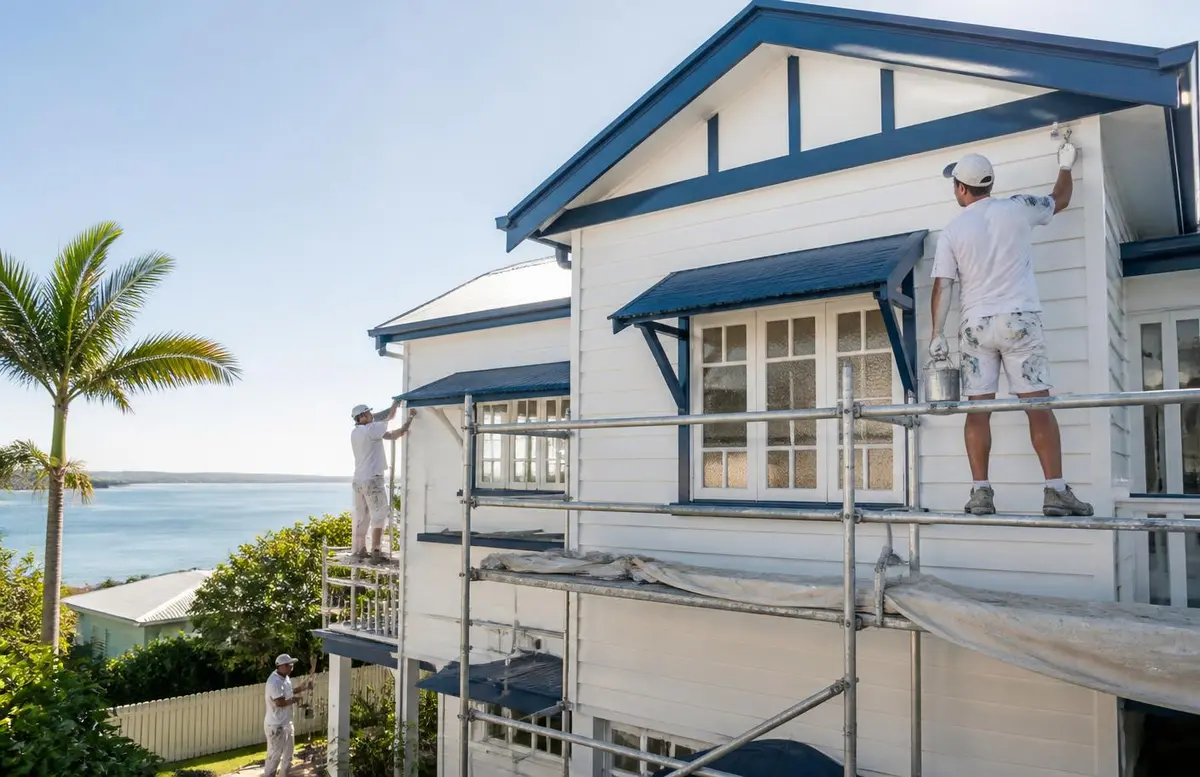
Decks, fences, rails and suitable metalwork prepared for coastal weather. We identify the existing coating, clean and sand back, then apply the paint, stain or oil that suits the timber and the look you want.
Decks and fences weather faster than sheltered interior surfaces. The right approach depends on timber condition, previous coatings, exposure and whether a painted, stained or natural finish is wanted.
Timber decks, verandahs, pergolas and fences take a real beating in Hervey Bay’s climate — direct UV overhead, salt-laden air rolling in off the water, and humidity that keeps timber damp for longer after rain than it would inland. House Painters Hervey Bay coats and restores decks, verandahs, pergolas, handrails, and timber and Colorbond fencing across Pialba, Scarness, Torquay, Urangan and surrounding suburbs, using preparation and products matched to how exposed each structure actually is. Call now on +61 483 709 394 to get your deck or fence assessed.
Outdoor timber structures are the most exposed surfaces on any property, and in Hervey Bay that exposure is intensified by salt air, high UV and humidity that slows drying after rain or heavy dew. Left untreated or under a failing coating, timber greys, splits and checks, fasteners rust and stain the surrounding timber, and end grain absorbs moisture that drives rot from the inside out. Fences face a slightly different set of pressures — ground contact moisture at post bases, weed and lawn trimmer damage at the bottom rail, and constant sun exposure on north and west-facing faces that fades colour unevenly compared with the shaded side.
Common across established homes in Torquay and Point Vernon and newer builds around Urraween and Eli Waters, timber decks need a coating chosen for foot traffic wear as much as weather resistance.
Pergola timber, especially overhead beams, takes constant direct UV exposure with less foot-traffic wear, so the coating priority shifts more towards UV protection and less towards abrasion resistance.
Handled frequently by hand, handrails need a smooth, durable finish that won’t feel rough or shed under regular contact, and they’re inspected closely for splinters and checking during preparation.
Timber fencing around properties in Kawungan, Dundowran and Craignish typically shows the most uneven fading between sun-facing and shaded sides, and gate hardware needs care during masking and coating.
Colorbond fencing generally needs less frequent attention than timber but can chalk and fade over the years, particularly on boundary fences facing the prevailing sea breeze, and benefits from a dedicated metal-suited coating when it’s repainted or touched up.
Choosing between an oil, a stain or a solid paint finish depends on the timber species, the amount of foot traffic, and how much of the natural timber grain you want visible:
For hardwood decks that are structurally sound but weathered, oils and stains are often preferred to retain the timber’s natural character. For softer timbers or decks where appearance matters more than grain visibility, a solid deck paint system can offer better long-term durability.
Grey, weathered timber is the most common condition we see on unmaintained decks and fences in Hervey Bay — it’s a sign the surface fibres have broken down under UV exposure and any remaining coating has failed. Preparation typically involves sanding back to expose sound timber underneath, or chemical or mechanical stripping where old coatings have built up in layers and simple sanding won’t cut through them efficiently. This step is critical: applying a new oil or stain over grey, degraded timber fibres gives the new coating almost nothing sound to bind to, and it will fail quickly.
Before coating, deck boards are checked for popped or protruding nails and screws, which are punched below the surface or replaced, along with a check for cracked, cupped or checking boards that may need replacing rather than simply coating over. Loose balustrade posts, worn stair treads and any soft or rotten sections are flagged at this stage too, since coating can’t fix a structural timber problem.
Hervey Bay’s humidity means mould and mildew growth on shaded deck areas, under pergolas and on the damp side of fences is common. These are treated with an appropriate cleaner before coating, since painting or oiling over active mould growth traps it under the new finish rather than resolving it. Tannin bleed — the brownish staining that comes from naturally occurring tannins in some hardwood species, especially when the timber gets wet before it’s properly sealed — is managed with a tannin-blocking primer or sealer where the timber species is known to be prone to it.
End grain — the cut ends of deck boards, fence posts and rails — absorbs moisture far faster than the face grain of the timber, and it’s one of the most common starting points for rot if left unsealed. As part of a proper coating job, exposed end grain on deck boards and fence posts is specifically sealed, which is a step that’s easy to skip but makes a real difference to how long the coating and the timber underneath both last.
Deck surfaces, particularly steps and areas near pools or outdoor living spaces, benefit from a non-slip additive mixed into the coating or a textured finish, especially given how often Hervey Bay decks get wet from rain, pool splash-out or morning dew. This is a straightforward addition at coating time and is worth discussing upfront if the deck is used barefoot or gets wet regularly.
Usually caused by coating over damp, dirty or unsound timber; solved by stripping back, drying out the timber and reapplying to a properly prepared surface.
Sanded back to sound timber, treated for mould if present, and recoated with a UV-stable stain or paint system.
Fasteners are replaced or treated, and the surrounding timber is cleaned and spot-treated before recoating to stop staining recurring.
Addressed by fully recoating both faces with a UV-stable product rather than only touching up the more exposed side.
We’ll assess the timber’s condition on-site and talk through whether oil, stain or paint suits your deck or fence, factoring in how the structure is used and how exposed it is to sun and rain. Coating work is timed around dry weather and adequate drying windows between coats, which matters particularly during Hervey Bay’s humid summer months, and we’ll protect surrounding garden beds, pavers and outdoor furniture while work is underway.
Decks and pergolas close to the water in Urangan and along the Esplanade face the heaviest salt exposure and UV load, which shortens the practical life of oils compared with more sheltered properties further inland in Wondunna or Booral. Timber fences in older, established streets around Scarness and Pialba often show layered old coatings that need proper stripping rather than a simple recoat, while newer estates around Kawungan and Eli Waters more commonly have Colorbond fencing that just needs periodic cleaning and occasional touch-up painting. Dundowran and Dundowran Beach properties, being closer to bushland in places, sometimes see more shading and associated mould growth on decks and fences than open, breezier blocks elsewhere.
Oiled decks generally need reapplication more often than stained or painted ones, particularly on exposed north and west-facing sections, so a periodic light sand and re-oil keeps them protected before the timber greys again. Painted and solid-stained surfaces last longer between full recoats but still benefit from an annual wash-down to remove salt film, mould spores and general grime. For fences, keeping garden beds and mulch pulled back from the base of posts and pickets reduces moisture retention at ground level, which is one of the more common causes of premature rot in Hervey Bay’s humid conditions.
Not all timber behaves the same way under a coating, and knowing the species and rough age of a deck or fence changes the approach. Older hardwood that has been left bare or under a failed coating for years is often harder and denser than it was originally, which can make oils absorb unevenly until the surface is properly prepared, while newer or younger timber tends to take stains and oils more readily. Timber age also affects how much movement — cupping, checking and small surface cracks — has already occurred, which influences whether a flexible stain system or a more solid paint film is the better long-term choice.
Hardwood decking, common on older homes around Torquay and Point Vernon, is naturally durable and often suits an oil or semi-transparent stain that lets the timber’s grain and colour show through. Treated pine, more common in newer fencing and some deck framing around Kawungan and Eli Waters, is softer and more prone to surface fibre breakdown under UV, and often performs better under a solid stain or paint system that gives it fuller protection rather than a light penetrating oil.
Each element of an outdoor timber structure wears differently. Deck boards cop constant foot traffic, spilled drinks and grit tracked in from the yard, so they need a coating with some abrasion resistance built in. Handrails are handled by hand daily and need a smooth finish that won’t feel rough or shed a chalky residue onto palms. Pergola beams and rafters overhead get almost no foot traffic but take the most direct, unbroken UV exposure of any timber on the property, so a UV-stable product matters more there than abrasion resistance.
Colorbond fencing is common across newer estates in Kawungan, Eli Waters and Urraween, and while it needs far less frequent attention than timber, it does chalk and fade over the years, particularly on boundary fences that face the prevailing sea breeze off the water. Metal fence panels and gates are cleaned to remove chalking residue and salt film before any touch-up or repaint, and a coating specifically suited to factory-finished steel is used rather than a standard timber product, since the two substrates need different primers and adhesion approaches.
Timber and masonry retaining walls sit in a particularly harsh spot for coatings — constant contact with damp soil on one side, direct weather on the other, and often less airflow than a freestanding fence. Retaining wall timber is checked closely for rot at ground contact points and for drainage behind the wall that might be keeping the timber wetter than it should be, since no coating will outlast a wall that’s permanently saturated from behind. Masonry retaining walls are cleaned of efflorescence and grime before any coating or sealer is applied.
Decking and fencing around a pool face a double load in Hervey Bay — chlorinated splash-out in addition to the salt-laden air already common this close to the coast. Chlorine exposure can bleach and dull some coatings faster than plain weathering would, so pool-adjacent timber and metal often benefit from a coating rated for chemical exposure, and a slightly shorter maintenance interval than the same structure would need further from the pool. Fences and decks closer to the Esplanade and Urangan foreshore see a similar accelerated effect from pure salt spray, even without a pool nearby.
Beyond adding a non-slip additive at coating time, the texture and sheen level of the finish itself affects how a deck feels underfoot when wet. Higher-gloss finishes generally feel more slippery when damp than a satin or textured finish, which matters on steps, pool surrounds and any deck area that regularly gets wet from rain, splash-out or morning dew. We factor slip resistance into the product recommendation for these areas rather than treating it as an optional extra.
Coating timber that’s still holding excess moisture from recent rain, morning dew or a shaded, poorly ventilated position is one of the more common causes of early coating failure, since trapped moisture pushes back against the new finish from underneath. Where a deck or fence has been recently washed, is in a shaded position, or there’s any doubt after a run of wet weather, we check timber moisture before coating and hold off until it’s dried out sufficiently, rather than coating to a schedule and risking a finish that fails within months.
Most decks, verandahs and fences in this climate benefit from a simple annual rhythm rather than waiting until a full restoration is needed: an annual wash-down to remove salt film, mould spores and general grime before it builds up; a visual check each year for popped fasteners, early tannin bleed or fresh mould in shaded corners; and a periodic light sand and recoat on oiled surfaces, timed before the timber greys rather than after. Fences and decks closest to the water around Urangan and the Esplanade generally need this rhythm followed more tightly than more sheltered properties inland around Wondunna or Booral, simply because the UV and salt exposure is higher. Call now on +61 483 709 394 if you’d like an assessment of where your deck or fence currently sits in that cycle.
From washing and repairs to primers and finish coats, understand the complete process.
Read the guideA practical guide to the preparation, access, materials and scope decisions that shape a written painting quote.
Read the guideWhat to inspect after humid summers, salt exposure and periods of heavy rain.
Read the guideIt depends on the timber species, how much foot traffic the deck gets, and whether you want the natural grain visible; we’ll recommend the best option after assessing your deck on-site.
Oiled decks generally need more frequent reapplication than stained or painted ones, especially on sun-exposed faces, and salt-air exposure near the water shortens the interval further.
Yes, weathered grey timber is sanded or stripped back to sound fibres before a new coating system is applied, which is essential for the new coating to bond and last.
Yes, mould and mildew are treated with an appropriate cleaner before any coating is applied, since coating over active growth traps it underneath.
End grain is the cut ends of timber boards and posts, which absorb moisture far faster than the face grain; sealing it specifically helps prevent rot starting at these vulnerable points.
Yes, non-slip additives can be mixed into the coating for decks and steps, which is worth considering for areas near pools or used barefoot.
Yes, we repaint and touch up Colorbond fencing using coatings suited to metal, as well as timber fences and gates.
That’s typically tannin bleed from the timber itself, which is managed with a tannin-blocking primer or sealer before the topcoat is applied.
Minor repairs such as nail punching and board checks are part of our preparation process; more significant structural repairs are flagged so you can decide on repair versus replacement.
Yes, we assess and coat timber and masonry retaining walls, checking for rot at ground contact points and drainage issues before recommending a coating.
Yes, chlorinated splash-out can bleach and dull some coatings faster than normal weathering, so pool-adjacent timber and metal often need a chemical-resistant coating and a shorter maintenance interval.
Yes, we check for excess moisture after recent rain or washing and hold off coating until the timber has dried sufficiently, since coating over damp timber is a common cause of early failure.
We work across Pialba, Scarness, Torquay, Urangan, Point Vernon, Kawungan, Urraween, Eli Waters, Dundowran, Dundowran Beach, Craignish, Nikenbah, Wondunna and Booral.
Call our Hervey Bay painting team during business hours and describe the property. We will arrange an on-site assessment and a written quote.
Speak to a Hervey Bay painter about your project and book an on-site assessment.